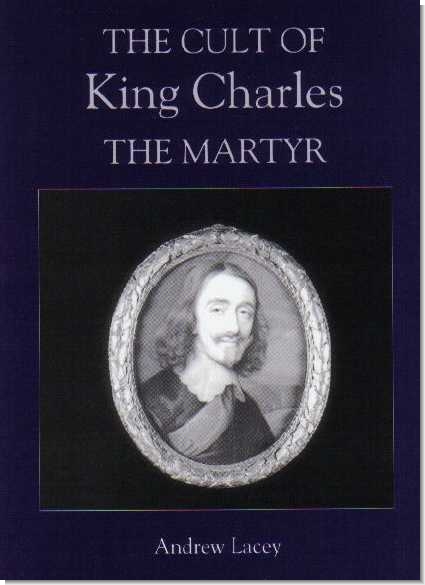
| THE CULT of King Charles the
Martyr did not spring into life fully formed in January 1649; rather, its component parts
were fashioned during Charles's captivity and were readily available to preachers and
eulogists in the weeks and months after the regicide. However, it was the publication of
the Eikon Basilike early February 1649 that established the image of Charles as a
suffering, innocent king, walking in the footsteps of his Saviour to his own Calvary at
Whitehall. The figure of the martyr and the shared set of images and beliefs surrounding
him contributed to the survival of royalism and Anglicanism during the years of exile. With the Restoration, the cult was given official
status by the annexing of the Office for the 30th January to the Book of Common Prayer in
1662. The political theology under-pinning the cult and a particular historiography of the
Civil Wars were presented as the only orthodox reading of these events. Yet from the
Exclusion Crisis onwards dissonant voices were heard challenging the orthodox
interpretation. In these circumstances the cult began to fragment between those who
retained the political theology of the 1650s and those who sought to adapt the cult to the
changing political and dynastic circumstances of 1688 and 1714.
This is the first study to deal exclusively
with the cult and takes the story up until 1859, the year in which the Office for the 30th
January was removed from the Book of Common Prayer. Apart from discussing the origins of
the cult in war, revolution and defeat it reveals the extent to which political debate in
the late seventeenth and early eighteenth centuries was conducted in terms of the Civil
Wars. It also goes some way to explaining the persistence of conservative assumptions and
patterns of thought.
Avalable from *Boydell & Brewer and Amazon UK. Please
check your local Amazon website for pricing details.
REVIEWS
Scholarly, readable, stimulating, and
approachable. CHURCH TIMES
By placing before us a considerable,
informed, and often sensitive reading of material too easily dismissed as predictable and
unenlightening, Lacey has offered both a foundation for further studies and a well-placed
stepping stone for others' journeys. H-NET BOOK REVIEWS
Scholarly, insightful, and
thought-provoking...[a] groundbreaking study. REVIEWS IN HISTORY
It is a tribute to this intelligent,
fascinating and cogent study that it provokes far-reaching reflection. ENGLISH HISTORICAL
REVIEW
A major contribution to early modern
British history. JOURNAL OF MODERN HISTORY
Original in its treatment of the origins
and early development of the cult of Charles I as martyr in the 1640s and 1650s.... An
important contribution towards a better understanding of what was in the king's mind and
what were the beliefs of his supporters. HISTORY
A valuable study of the materials of
Charles' memorialization and the pressures that made the myth. AMERICAN HISTORICAL REVIEW
Should be read by anyone interested in
royal culture and its evolution over time. HISTORICAL JOURNAL
Top of Page |





 Home
Home